

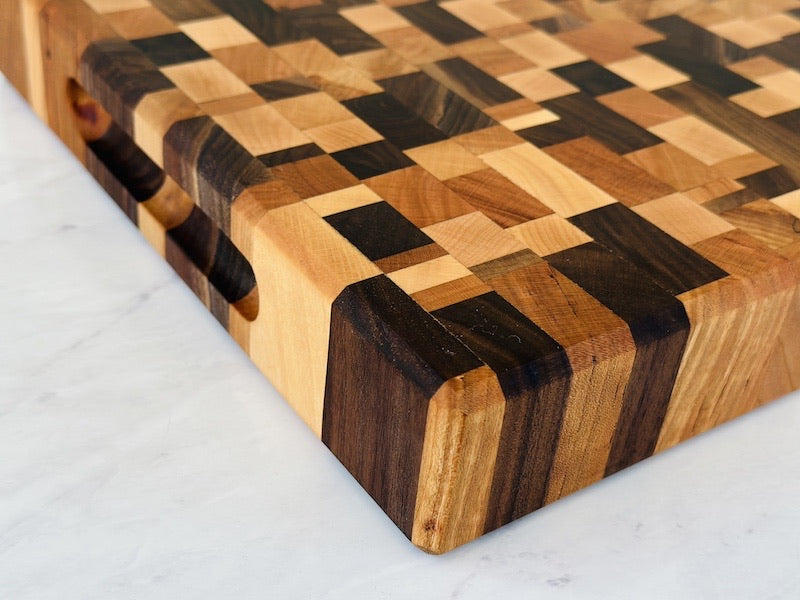
THE REASONS WE USE WALNUT, CHERRY, AND MAPLE HARDWOODS
When you are looking for a high-quality cutting board that will enhance your kitchen experience and last for years, you should consider choosing one made from walnut, cherry or maple. These three wood species make some of the best cutting boards because they have properties which make them ideal for food preparation and hygiene, while still adding a beautiful feature to your kitchen.
Here are some of the reasons we only use walnut, cherry and maple when creating our cutting boards:
-They are all close-grained hardwoods. This means they have small, tight pores which aides in preventing moisture, bacteria and stains from penetrating the woods surface. As a result, they more sanitary and easier to clean than open-grained woods like oak or ash, which have large pores that can trap dirt and germs. Close-grained hardwoods are also more durable and resistant to scratches, dents and knife marks than softwoods like pine or fir, which can dull your knives faster.
- All three have natural antibacterial properties. Walnut, cherry and maple wood contain tannins and other compounds which inhibit the growth of bacteria and fungi on the wood surface. This reduces the risk of cross-contamination and food poisoning when using our cutting boards. These woods do not absorb odors or flavors from the foods you cut on them, unlike plastic or bamboo cutting boards, which can retain smells and tastes over time as well as trapping bacteria in the permanent scarring of the surfaces of those products.
- As a side note: we do not use softwoods or woods with leachable toxins for our cutting boards. Despite the beauty of softwood evergreens and cedar they should never be used for a cutting board. These woods are more porous and prone to absorbing juices from raw meat, which can lead to mold growth, wood warping, or stains. They are less durable and can dull your knives faster. Woods with leachable toxins include exotic woods like the seemingly popular purple heart, which may contain chemicals that can contaminate your food. You should also avoid using open-grained woods which have large pores that can trap bacteria and moisture. We are concerned with the recurring use of some of the woods, like purple heart which is too frequently used by individuals because they like the contrasting colors, but putting them into the hands of less informed consumers is ill-advised and potentially dangerous if used by an unknowing consumer. Additionally, you should also avoid food contact items made from Cocobolo, Rosewood, Oleander and Teak due to potential exposure to toxins. Given the inherent beauty of our wood choices we cannot justify producing goods which might compromise the health of consumers.
- They are easy to maintain and care for. Walnut, cherry and maple cutting boards only require occasional oiling with food-grade mineral oil to keep them from drying out and cracking. Oiling also helps to preserve the natural color and grain of the wood, which will enhance the beauty of your kitchen. Our boards are given an extra layer of protection with an application of our own combination of mineral oil and beeswax BeeNew™. Each board is shipped out with a complimentary container of our wax to make sure you are able to maintain the original beauty of your board after having had the opportunity to use your board at home. We also encourage you to avoid soaking your cutting board in water or putting them in the dishwasher, as this can cause them to warp or split. Instead, you should wash them by hand with warm water and mild soap, and dry them thoroughly after each use.
Bon Appetite!
R. Parkinson
Leave a comment
Also in THE WOOD FILES
The Big Summer Plan
By Michele Parkinson July 18, 2026
No one ever thinks about all the little things that go into painting a house. This isn't even our first time painting an exterior, but we still thought, “Our house is small, this shouldn’t take that long.”
Continue reading
THE PURSUIT OF VALENTINES DAY TRIVIA
By Michele Parkinson January 21, 2026
In the 1800s, doctors frequently advised heartbroken patients to eat chocolate to "calm their pining" for lost love.
Continue reading
THE REASONS BEHIND OUR NEED TO CLEAN, ORGANIZE AND BUY PLANNERS IN JANUARY
By Michele Parkinson January 20, 2026
Our obsession with planners is a fascinating mix of ancient tradition, retail psychology, and a specific cognitive quirk known as the "Planning Fallacy." If you are someone who buys a beautiful new planner every January only for it to become a glorified paperweight by March, you are definitely not alone. Here are some of the most interesting facts about our "Planner Obsession":
Continue reading